![90s.pm.investing [EN]](https://substackcdn.com/image/fetch/$s_!gwa6!,w_120,h_120,c_fill,f_webp,q_auto:good,fl_progressive:steep/https%3A%2F%2Fsubstack-post-media.s3.amazonaws.com%2Fpublic%2Fimages%2F101bbd96-f32d-47f3-bb0e-9c76efa580c0_1054x1054.png)
Advanced Micro Device (AMD) - We Draw Tree
GPU or CPU? Hypothesis Driven | Mutually Exclusive | Collectively Exhaustive

I. Who Is AMD?
AMD is America’s second-largest x86 semiconductor design company, founded in 1969 and headquartered in Santa Clara, California. Over the past decade, under Lisa Su’s leadership, AMD completed a transformation from “perpetual challenger” to “structural share taker”: EPYC climbed from near-zero share in 2018 to nearly 40% of x86 server revenue in Q1 2026. AMD’s core DNA is “trading design performance for TCO advantage” — it owns no fabs, relying entirely on TSMC, concentrating capital on CPU and GPU architecture innovation. Versus Intel, AMD carries no manufacturing process baggage. Versus NVIDIA, AMD’s differentiation is that it owns both server CPU and GPU, theoretically enabling a “full-stack” AI infrastructure solution.
II. How Does AMD Make Money?
AMD Q1 2026 total revenue came in at $10.3B, up 38% year-over-year. The Data Center segment led with $5.8B (+57% YoY), now representing 56% of company revenue, powered by EPYC Turin CPU and Instinct MI350 GPU. The Client segment (Ryzen) contributed $2.9B (+26% YoY, 28% mix), driven by AI PC and commercial notebook share gains. Gaming delivered $720M (+11% YoY, 7% mix) with Radeon 9000 momentum partially offset by semi-custom decline. Embedded rounded out the mix at $870M (+6% YoY, 9% mix), reflecting a gradual recovery in T&M, aerospace, and communications.
The Data Center segment is now the company’s primary revenue and earnings growth engine, generating $1.6B in segment operating profit at a 28% margin — up from 25% a year ago. Two engines are reshaping the company’s profile: EPYC CPU continuing to take Intel share, and Instinct GPU moving from pilot to production-scale deployment.alphaspread
III. What Has AMD Been Doing Recently?
Q1 2026 Data Center hits another record; management dramatically raises TAM outlook. On the Q1 earnings call, Lisa Su publicly raised the server CPU TAM forecast from the 2025 Analyst Day’s ~18% annual growth ($60B by 2030) to >35% annual growth (over $120B by 2030), citing Agentic AI as driving a structural acceleration in CPU demand.
MI450 enters customer sampling. Management confirmed the MI450 series has begun sampling to key customers, with the Helios rack platform development milestones progressing on schedule; H2 2026 production shipment plan unchanged. Customer forecasts have already exceeded initial plans, with new multi-gigawatt opportunities added.
Meta 6GW agreement formalized + OpenAI 1GW deployment on track. The AMD-OpenAI agreement announced in October 2025 (6GW commitment, MI450 starting with 1GW) was reaffirmed as on track in Q1 earnings; Meta also added commitments for up to 6GW of custom MI450 deployments.
EPYC Venice (6th gen, TSMC 2nm) roadmap strengthened. The Venice family introduces Verano — the first EPYC processor optimized for AI infrastructure — with up to 256 cores and PCIe 6.0-class interconnects. Management stated early customer validation volumes exceed any prior EPYC generation.alphaspread
Intel Q1 2026 brief recovery, but structural issues unresolved. Intel Q1 2026 non-GAAP EPS of $0.29 beat expectations, with Q2 guidance of $13.8–14.8B in revenue; but Clearwater Forest (Intel 18A’s first server product) status remains uncertain, and server share continues to flow toward AMD.
IV. Market Consensus (Narrative Version Evolution)
Narrative Version Timeline
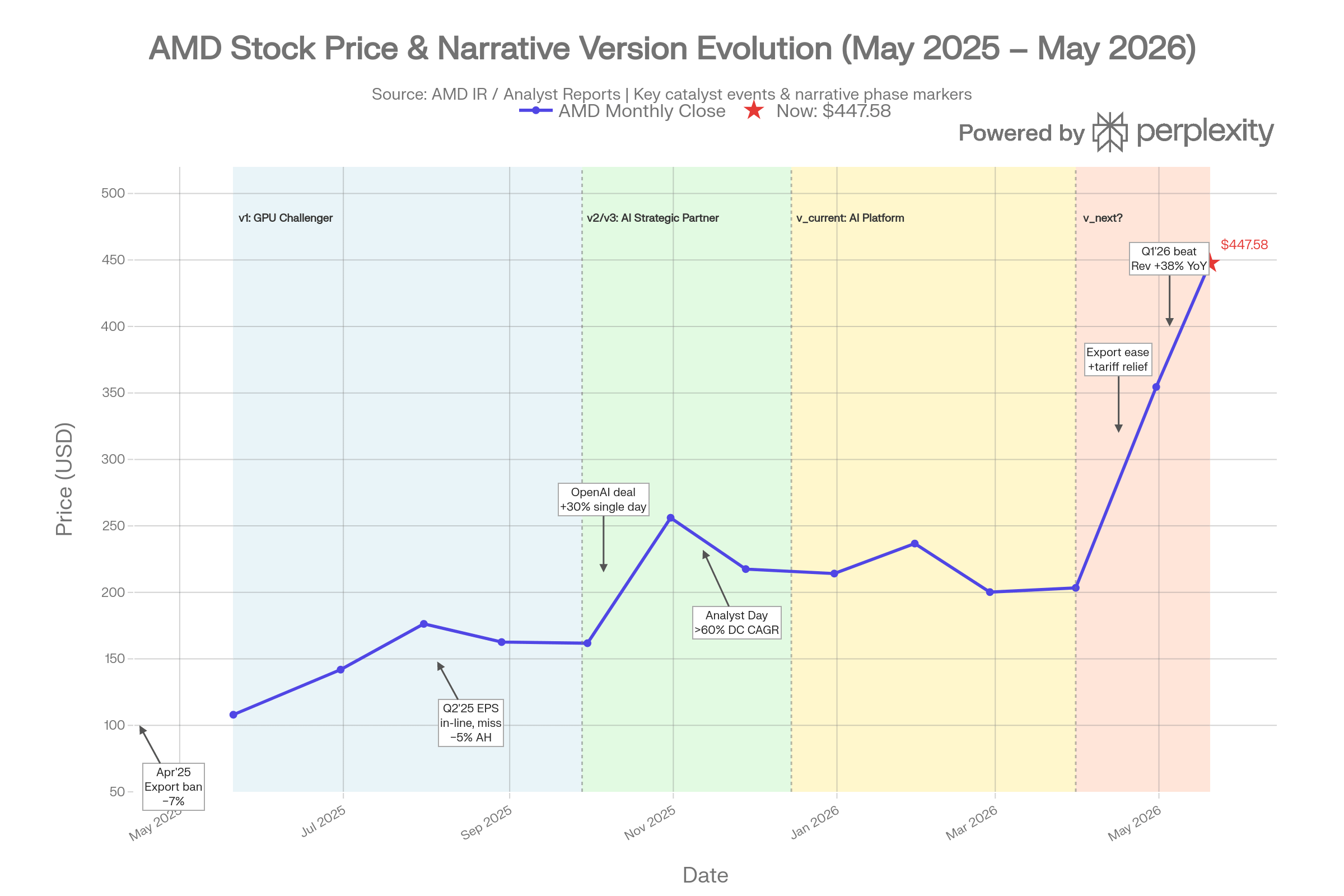
AMD’s narrative has evolved through four distinct versions over the past year.
v1 (May–July 2025) cast AMD as NVIDIA’s only credible AI GPU competitor, with MI300X’s high-memory specs offering cost advantages in inference and China hyperscaler demand providing near-term excess growth. The market used an EV/Revenue framework at a growth discount to NVDA, pricing in a 10–15% AI GPU market share possibility and EPYC at 25–30% server share. This version collapsed when China export bans eliminated sustainability assumptions and an EPS miss exposed that earnings conversion was incomplete.alphaspread
v2 (August–early October 2025) repriced AMD lower, with the China AI chip business restricted and GPU market share expansion discounted by regulatory uncertainty. The MI308 export ban, a -$800M Q2 impact, and a KeyBanc downgrade deepened the EV/Revenue discount. This version ended when OpenAI’s strategic investment redefined AMD’s customer identity entirely.logisticsviewpoints
v3 (October 2025–early February 2026) repositioned AMD as the second core chipmaker for the OpenAI/AI ecosystem, with the AMD-OpenAI multi-year deal sending the stock up 34% in a single day. The Analyst Day’s >35% CAGR target drove a framework migration from EV/Revenue toward NTM PE, with sell-side beginning to build targets at 35–37x NTM EPS. OpenAI contract revenue streams and GPU roadmap visibility (MI450) were the key priced-in assumptions. This version gave way when Lisa Su’s doubling of the CPU TAM from $60B to $120B+ revealed an unpriced “GPU + CPU dual-track” architecture.alphaspread
v_current (February 2026–present) frames AMD as the AI infrastructure “dual-engine platform” — Instinct GPU for inference/training acceleration, EPYC CPU for Agentic AI orchestration — with both benefiting from the global AI capex explosion. Q4 2025 and Q1 2026 earnings beats, the CPU TAM doubling statement, and Goldman/BofA/Barclays price target jumps anchored the NTM PE 35–37x framework, with some sell-side introducing EV/EBITDA alongside a CPU TAM lens.
What remains pending: MI450 actual shipment volumes, CPU TAM acceleration data, and Agentic AI procurement budgets upgrading from pilot to scale.
v_next (candidate) envisions AMD as the x86 CPU dominant in an AI infrastructure “dual-track monopoly” — Agentic AI’s explosive CPU demand (100–200M cores/year) makes EPYC a mandatory data center component, CPU TAM expands from $60B to $120B+ (According to AMD CEO Lisa Su during the earning call), and AMD graduates from discounted AI challenger to full AI infrastructure provider in the mold of NVIDIA with x86.
The framework shift target is from NTM PE 35x toward an AI Infrastructure Platform multiple of 40–50x forward PE. This version is not yet sufficiently priced in and awaits:
MI450 mass shipment in H2 2026
Agentic AI enterprise procurement acceleration
EPYC server share breaking 40%, and CPU TAM data being formally tracked by institutional research.
